If you’ve ever stood at the crossroads of choosing between personal training and group fitness classes, you’re not alone. This is one of the most common dilemmas facing anyone serious about their fitness journey. Should you invest in one-on-one training sessions, or join the energy of a packed spin class?
Here’s the truth: there’s no universal “right” answer. Both options deliver real results, but they serve different needs, personalities, and goals. The key is understanding which approach aligns with YOUR lifestyle, budget, and fitness objectives.
In this guide, we’ll break down everything you need to know about personal training and group fitness classes. You’ll discover the benefits and drawbacks of each, see how they compare side-by-side, and walk away with a clear framework for making the best decision for your unique situation. Whether you’re a complete beginner stepping into a gym for the first time or an experienced athlete looking to optimize your training, we’ll help you find the path that gets you to your goals faster. Let’s dive in.
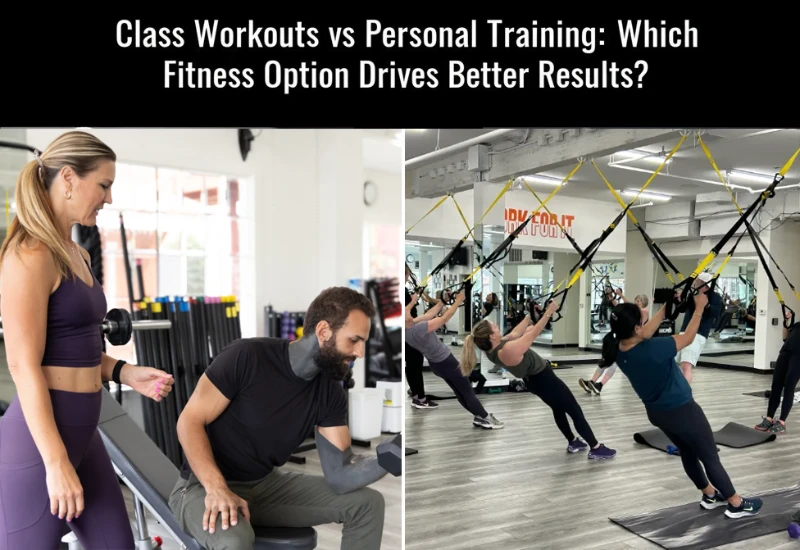
Class Workouts vs Personal Training: Which Fitness Option Drives Better Results?
Personal training is exactly what it sounds like—one-on-one fitness coaching tailored specifically to you. When you work with a personal trainer, you’re getting undivided attention from a certified professional who designs every workout around your body, your goals, and your current fitness level.
Key Benefits of Personal Training: Expert Guidance, Injury Prevention, and Accountability
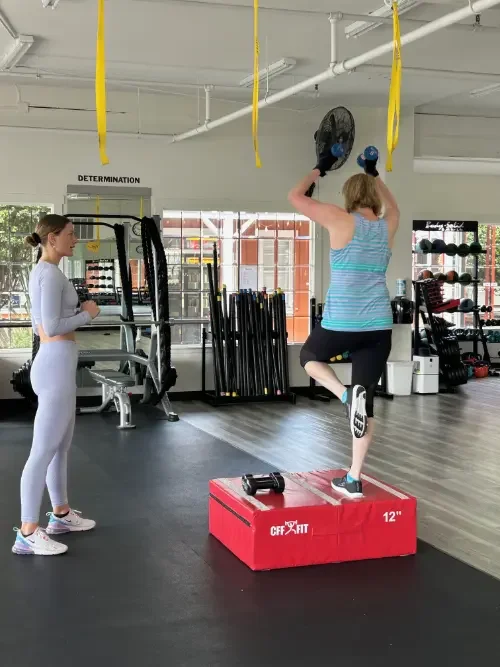
Customization is the biggest advantage. Your trainer builds a program that accounts for your specific goals, whether that’s preparing for a marathon, recovering from an injury, building muscle for bodybuilding, or simply losing weight safely. They’ll modify exercises based on any limitations you have, from old knee injuries to shoulder mobility issues that might make certain movements risky.
Form correction happens in real-time. One of the most valuable aspects of personal training is having an expert watch your every rep. Poor form doesn’t just reduce effectiveness—it can lead to serious injuries. Your trainer catches these mistakes immediately and teaches you the proper mechanics before bad habits set in. This is especially crucial for compound movements like squats, deadlifts, and overhead presses where form makes all the difference.
Accountability reaches a new level. When someone is expecting you at the gym at 6 AM and you’ve paid for their time, you show up. That simple fact drives consistency better than any motivational poster. Beyond just getting you through the door, trainers push you harder than you’d push yourself, helping you break through plateaus and discover what you’re truly capable of achieving.
Goal-specific programming accelerates results. Want to add 50 pounds to your deadlift? Training for your first triathlon? Trying to drop 30 pounds before your wedding? A skilled trainer knows the exact progression needed to get you there, adjusting your program week by week based on your progress and recovery.
Who Should Choose Personal Training? Targeted Fitness for Specific Goals and Conditions
Personal training shines for people with specific, measurable goals that require expert guidance. If you’re recovering from an injury and need to rebuild strength safely, a trainer provides the medical exercise knowledge to progress without setback. Athletes preparing for competitions benefit from sport-specific programming that targets exact performance markers. Complete beginners often find personal training invaluable because it builds a foundation of proper movement patterns from day one, preventing the injuries that often derail newcomers who try to figure everything out alone.
People with unique physical considerations—whether that’s chronic pain conditions, significant weight to lose, or previous injuries—need the individualized attention that only personal training provides. The same goes for anyone who’s tried group settings before and found themselves lost, unable to keep up, or feeling invisible in a crowd.
Personal Training Costs: What to Expect and How to Maximize Your Investment
The cost is the most obvious limitation. Personal training simply isn’t accessible to everyone’s budget, especially when you’re committing to multiple sessions per week over several months. Even for those who can afford it, the expense can become difficult to justify once you’ve learned the fundamentals and could potentially train independently.
Trainer compatibility matters more than you might think. Personalities, communication styles, and training philosophies vary widely among trainers. Finding the right match sometimes takes trial and error, and a mismatch can make sessions feel like a chore rather than an investment in yourself. The relationship needs to feel supportive, challenging, and motivating all at once.
Schedule inflexibility can create challenges. You’re coordinating with another person’s calendar, which means less freedom than simply showing up to a gym whenever you want. Highway 1 Fitness trainers book up quickly, and if you need to reschedule, you might lose that time slot or even pay a cancellation fee.
Personal Training Costs at Highway 1 Fitness
Personal training is the premium option in the fitness world, and the price reflects that specialized attention. Highway 1 Fitness is no exception. Private session in our studio will cost $110 per hour. (Source: Highway 1 Fitness Pricing)
We also offer packages that reduce the per-session cost. A package of 6 sessions for example is $630. If you’re training 2-3 times per week, you’re looking at a monthly investment of $600 to $1,200. That’s a significant commitment, but for many people, the accelerated results and injury prevention make it worthwhile.
Group Fitness Classes: Community-Driven Workouts That Boost Motivation
Group fitness classes bring together anywhere from 5 to 50 people (sometimes more) for instructor-led workouts that follow a set format. From the high-intensity intervals of a cycling class to the flowing movements of yoga, group fitness encompasses an enormous variety of workout styles, all built around the shared energy of exercising together.
Popular Types of Group Fitness Classes: From HIIT to Yoga and Dance
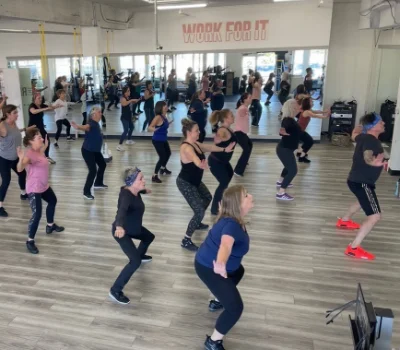
The modern group fitness landscape offers something for virtually every interest and fitness level. High-intensity options like CrossFit, bootcamp classes, and HIIT workouts deliver maximum calorie burn and cardiovascular challenge. Mind-body classes including yoga, Pilates, and barre focus on flexibility, core strength, and the connection between movement and breath. Dance-based formats like Zumba and hip-hop cardio make exercise feel more like a party than work. Cycling classes (both indoor and rhythm-based) provide low-impact cardiovascular training with adjustable intensity. Strength-focused classes using weights, resistance bands, or bodyweight challenge your muscular endurance in a group setting.
Benefits of Group Fitness: Social Support, Variety, and Cost-Effective Exercise
Community creates powerful motivation. There’s something uniquely energizing about working out alongside others who are pushing through the same challenging workout. You feed off each other’s energy, and the group dynamic often pushes you harder than you’d push yourself alone. Many people form genuine friendships through regular class attendance, turning workout time into social time that you actually look forward to.
Cost-effectiveness makes fitness accessible. At Highway 1 Fitness, there are several flexible options to fit different budgets and attendance levels. Our in-studio class passes range from $25 for a single drop-in to $19–$21 per class if you buy a multi-class pack. Highway 1 Fitness
If you workout regularly, their unlimited monthly “BREEZE” pass costs $265 for unlimited in-studio classes. Highway 1 Fitness Even their less-frequent options — like the BEACH pass (14 classes/month for $185) or WAVE pass (21 classes/month for $225) — bring your per-class cost well under what many boutique personal training sessions charge. Highway 1 Fitness
When you compare this to personal training — which costs $110 for a single 55-minute session at Highway 1 — choosing group classes offers a dramatically more affordable way to get expert coaching.
Variety prevents workout boredom. When you have access to multiple class types throughout the week, you can mix high-intensity cardio on Monday with strength training on Wednesday and yoga on Friday. This variety keeps exercise mentally engaging while ensuring balanced fitness development across cardio, strength, and flexibility.
The fun factor cannot be overstated. Great instructors bring infectious energy, carefully curated playlists, and enough personality to make an hour of burpees somehow enjoyable. The entertainment value of group classes helps exercise feel less like an obligation and more like something you genuinely want to do.
Structure removes decision fatigue. You don’t need to plan your workout, count your reps, or track your intervals. You simply show up and follow the instructor’s lead. For people overwhelmed by the infinite choices in a gym, this simplicity is liberating.
Who Group Fitness Works Best For
Group classes excel for people seeking general fitness improvements—better cardiovascular health, weight management, increased strength, and enhanced flexibility. If you thrive in social environments and draw energy from being around others, the community aspect becomes a powerful motivator that keeps you consistent.
Budget-conscious exercisers get exceptional value from group classes. For the price of 1-2 personal training sessions, you can attend unlimited classes for an entire month. People who get bored easily benefit from the variety and changing formats that keep workouts fresh and engaging.
The group setting also works well for intermediate exercisers who understand basic movement patterns and can self-correct their form. If you already know how to squat, lunge, and press properly, you can safely participate in most classes without constant individual correction.
Limitations of Group Fitness: Less Personal Attention and Fixed Schedules
Limited individual attention is the tradeoff for affordability. In a class of 20-30 people, the instructor simply cannot watch everyone closely. Form errors might go unnoticed, especially if you’re positioned in the back or if the instructor is focused on demonstrating the next movement. For beginners still learning proper mechanics, this lack of feedback can lead to injury or inefficient movement patterns that become habits.
One-size-fits-all programming doesn’t account for individual needs. The workout is designed for the average participant, not for you specifically. If you have an old shoulder injury that makes certain movements painful, you’ll need to modify on your own. If the class intensity is too easy or too hard for your current fitness level, you’re left to adjust independently. At HWY1 Fitness, we ask that you let your instructor know of any injury/ailments. She/He will provide a modification or alternative exercise.
The intimidation factor affects newcomers. Walking into a packed class where everyone seems to know the choreography can feel overwhelming. The fear of looking foolish or not keeping up stops many people from even trying group fitness. Some instructors are excellent at making newcomers feel welcome, but not all classes create that inclusive atmosphere.
Schedule constraints limit flexibility. Classes happen at fixed times, and if the yoga class you love is only offered at 6 AM on Tuesdays, you either make that time work or you miss out. Unlike personal training where you can schedule around your life, classes require you to fit your life around the schedule.
Limitations of Group Fitness: Less Personal Attention and Fixed Schedules
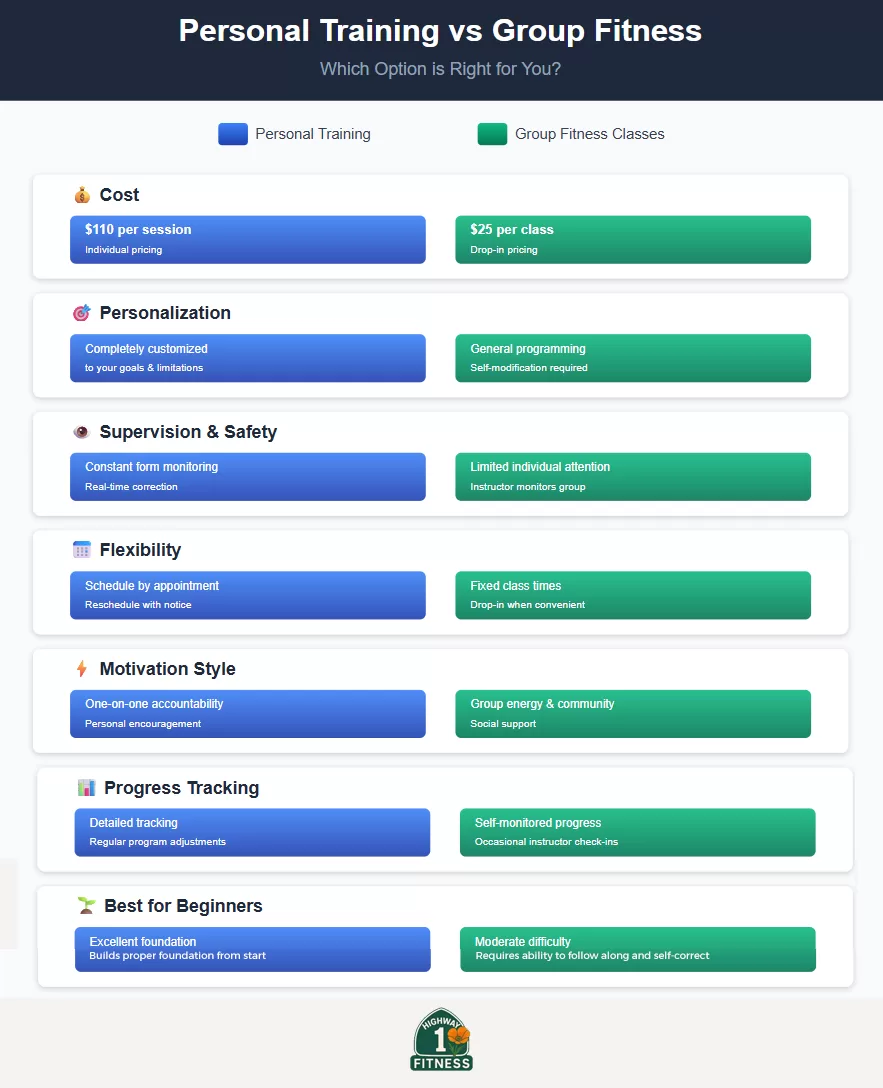
| Factor | Personal Training | Group Fitness Classes |
| Cost | $110 per session; See pricing options | $25 per class drop-in; See pricing options |
| Personalization | Completely customized to your goals, body, and limitations | General programming for average participant; self-modification required |
| Supervision & Safety | Constant form monitoring and real-time correction | Limited individual attention; instructor monitors group overall |
| Flexibility | Schedule by appointment; reschedule with notice | Fixed class times; drop-in when convenient but can’t change class timing |
| Motivation Style | One-on-one accountability and encouragement | Group energy and community support |
| Progress Tracking | Detailed tracking and regular program adjustments | Self-monitored progress; occasional instructor check-ins |
| Best for Beginners | Excellent—builds proper foundation from start | Moderate—requires ability to follow along and self-correct |
| Best for Advanced | Excellent for specific goals (competition, performance) | Good for maintenance and variety; less optimal for specialized training |
| Injury Accommodation | Exercises modified specifically for your limitations | You must know how to modify independently |
| Workout Variety | Varies by trainer; may feel repetitive with same person | High variety across different class types |
| Social Component | Private, focused environment | Community building and social interaction |
| Learning Curve | Trainer teaches you everything you need | Steeper curve to understand class choreography and cues |
How to Choose Between Personal Training and Group Fitness: A Practical Decision Guide
The best choice depends on your specific circumstances, goals, and preferences. Here’s how to think through your decision:
If you have specific, measurable goals like preparing for a competition, recovering from an injury, or achieving a particular performance milestone (like running your first marathon or deadlifting twice your bodyweight), personal training provides the specialized programming and expert guidance you need.
Group classes follow general fitness principles that improve overall health but don’t typically include the periodization and specificity required for performance goals.
If you want community and general fitness improvements such as weight management, cardiovascular health, strength, and flexibility, group classes deliver excellent results at a fraction of the cost. The social energy and variety keep you engaged long-term, which matters more than perfect programming for general fitness goals. Consistency beats perfection, and if group classes keep you showing up, they’re doing their job.
If budget is your primary concern, group fitness offers unbeatable value. For the cost of 2-3 personal training sessions, you can access unlimited classes for an entire month. If you attend just 3-4 classes per week, your per-session cost drops to $16 per workout. That’s affordable fitness that delivers real results.
If you’re completely new to exercise and need foundational guidance, personal training provides the safest, most efficient path forward. A trainer teaches you proper form from day one, builds your confidence, and creates a program that progresses at exactly the right pace for your body. Yes, it costs more upfront, but the investment in learning correct movement patterns prevents injuries and plateaus that cost more in the long run. Consider even just 5-10 sessions to learn the basics, then transition to group classes once you’re confident.
If you thrive on social energy and feel motivated by exercising with others, group classes tap into that energy in a way personal training cannot. The shared struggle of a tough workout, the encouragement from classmates, and the friendships formed create a support system that keeps you consistent. For social exercisers, the community is half the value.
If you have significant weight to lose or chronic health conditions, personal training provides the individualized attention necessary to exercise safely and effectively. A trainer can design low-impact progressions that protect your joints while building strength and endurance. As you become fitter and more confident, you can transition to group classes for maintenance and variety.
If variety and fun are essential to your consistency, group classes win. The rotating formats, different instructors, and diverse workout styles prevent the monotony that causes many people to quit their fitness routines. Personal training with the same trainer doing similar workouts can feel repetitive over time.
What Research Says About Exercise Adherence: Social Support and Enjoyment as Key Drivers
Scientific research supports both personal training and group fitness, though they deliver results through different mechanisms.
A 2017 study published in the National Library of Medicine found that participants working with personal trainers showed significantly greater improvements in strength, body composition, and exercise adherence compared to those exercising independently. The key factors were the individualized programming and consistent accountability that trainers provided. However, the study also noted that cost was a significant barrier preventing many participants from continuing long-term.
Research on group fitness reveals different but equally valuable benefits. A 2017 study found that people exercising in group settings experienced a significant reduction in stress levels, alongside significant improvements in mental, physical, and emotional quality of life. Solo exercisers saw no significant changes in these areas despite putting in the same workout time. The researchers concluded that the community aspect of group exercise provides psychological benefits that extend beyond the physical workout itself.
A 2019 systematic review in the Journal of Science and Medicine in Sport examined personal training effectiveness specifically. The analysis found that personal training produced superior results for strength gains and body composition changes compared to unsupervised exercise, but noted that the quality of the trainer-client relationship was just as important as the programming itself. Poor trainer-client matches often led to dropout rates similar to unsupervised exercise.
Regarding adherence—which ultimately determines long-term success—research published in the National Library of Medicine found that social support and enjoyment were the strongest predictors of exercise consistency. This finding suggests that for many people, the motivational benefits of group classes may outweigh the technical advantages of personal training, simply because consistency matters more than perfection.
Maximizing Your Fitness Benefits: Combining Personal Training and Group Classes for Long-Term Success
Both personal training and group fitness classes are valid, effective paths to better health and fitness. There’s no objectively “correct” choice—only the choice that works best for your current situation, goals, and personality.
The most important decision isn’t whether to choose personal training or group classes. It’s the decision to start, stay consistent, and adjust your approach as you learn what works for your body and lifestyle.
Many successful fitness journeys begin with one approach and evolve into another as goals change and confidence builds.
If you’re still unsure, the best way to decide is to try both.
Highway 1 Fitness offers single use passes and discounted intro packages. Experience a few personal training sessions to feel the difference individualized coaching makes. Drop into several group classes across different formats to discover which styles resonate with you. Pay attention to which approach makes you excited to return, because that enthusiasm predicts consistency better than any other factor.
We understand that everyone’s fitness journey is unique. That’s why we offer both comprehensive personal training programs and a diverse schedule of group fitness classes designed for all levels. Our trainers take time to understand your specific goals and recommend the path most likely to get you there, whether that’s one-on-one coaching, our energizing group classes, or a strategic combination of both.
Ready to start? Join us for a trial class to experience the community energy of group fitness, or schedule a complimentary consultation with one of our trainers to discuss how personal training could accelerate your progress. The only wrong choice is waiting to begin.
Frequently Asked Questions: Switching Between Training Options, Overcoming Intimidation, and More
Can I switch between personal training and group classes?
Absolutely. Your fitness needs change over time, and your training approach should adapt accordingly. Many members start with personal training to build confidence and learn proper form, then transition primarily to group classes while maintaining occasional trainer check-ins.
How often should I do personal training?
For beginners, 2-3 sessions per week provides enough frequency to build skills and make steady progress. Intermediate and advanced exercisers often find that 1-2 sessions weekly gives them the guidance they need while staying cost-effective. Even monthly sessions can be valuable for program updates and form checks.
What if I’m intimidated by group classes?
This fear is incredibly common and completely understandable. Start with beginner-friendly class formats like basic strength training or gentle yoga. Arrive a few minutes early and introduce yourself to the instructor—let them know you’re new, and most will provide extra guidance and encouragement. Position yourself where you can see the instructor clearly. Remember that everyone in that room was a beginner once, and most people are too focused on their own workout to judge yours.
Are group classes good for weight loss?
Yes, when combined with proper nutrition. Group classes provide the calorie burn and muscle building that support weight loss, while the community and variety help you stay consistent long enough to see real results. High-intensity classes like HIIT, cycling, and bootcamp formats are particularly effective for fat loss.
Can beginners do group fitness classes?
Many classes welcome beginners, though some formats are more beginner-friendly than others. Look for classes labeled “all levels,” “beginner,” or “fundamentals.” Avoid advanced formats like CrossFit or power yoga until you’ve built a foundation. When in doubt, contact the instructor beforehand to ask if the class suits your fitness level.