

Most fitness routines fail only after a few weeks. This is due to poor planning and execution. Too many sessions, too much intensity, too little structure and no communal support.
Research from the British Journal of Health Psychology found it takes around 60 days to form a new exercise habit. That’s twice the 21-day figure most people believe. The gap between what you expect and what’s actually true is exactly where routines collapse.
What follows is a practical framework: how to set the goal, choose the format, build the schedule, and set up the systems that make showing up automatic instead of a daily decision.
Set fitness goals that actually work
“Get in shape” is not a goal. It’s a direction. Without something measurable attached to it, there’s nothing to pull you forward when motivation dips, and it will.
The SMART goal framework works here. Specific, measurable, attainable, relevant, time-bound. “Work out three times a week for the next eight weeks” is a goal. “Exercise more” is a wish.
More important than the framework is the reason behind it. What actually changes if you get this right? More energy. Less back pain. Keeping up on the coastal trail without stopping. Something personal and specific that pulls you forward on a Tuesday when you don’t feel like it.
Write it down. Put it somewhere visible. The goal keeps the routine alive in week three when the novelty is gone.
Know your fitness baseline before you start
Building a routine without knowing your baseline means no way to know what’s realistic, and no way to measure progress. Progress is what keeps people going.
Assess two things: how many days per week you’re currently moving, and whether you have any physical limitations or injuries. Both shape what a sensible first month looks like.
If you’re coming back after a long break, your starting point is lower than you remember. That’s not a problem. Ignoring it is. The person who starts at 60% and builds consistently beats the person who starts at 100% and burns out in two weeks.
Anyone with existing injuries or chronic conditions should check with a doctor before starting a new routine. Once cleared, there’s almost always a workout format that works around limitations, not against them.
Choose the type of exercise that actually fits your life
The best workout is the one you’ll show up for. Most people default to what they think they should do, run every morning, hit the gym alone, follow a YouTube routine, instead of what they’ll realistically maintain.
Three filters cut through the noise:
Do you need external structure? If self-motivation has failed you before, building your routine around fixed class times removes the “I’ll do it later” problem entirely. The 6pm spin class exists whether you feel like it or not. There’s no decision to make, just somewhere to be.
Do you need variety? Doing the same workout every session is one of the top reasons people quit after four to six weeks. Rotating through different formats keeps things from going stale. Yoga on Tuesday, something higher-intensity on Thursday, strength-focused work on Saturday.
Do you want community or do you prefer to workout alone? Some people push harder in a group. Others need quiet focus. Know which you are before committing to a format you’ll resent in month two.
At Highway 1 Fitness, classes include yoga, spin, Zumba, Spin, HIIT, and Pilates, each with a fixed schedule and an instructor running it. That variety within built-in structure solves two of the three filters. For anyone who wants more individualized programming, one-on-one personal training addresses all three.
Build a workout schedule before motivation fades
Motivation spikes when you start and fades right around week two or three, which is exactly when the habit hasn’t taken hold yet. Waiting for motivation to show up is a losing strategy.
Build the schedule first. Decide the days and times in advance. Block them on your calendar like appointments.
For frequency, here’s a practical guide:
- Beginners: two to three sessions per week. Enough to build a pattern, not so much that it breaks you before you get started.
- Building momentum: three to four sessions once the first four weeks feel manageable.
- Long-term: four to five sessions, with at least one active recovery day, walking, stretching, mobility work.
A focused 45-minute class outperforms a distracted 90-minute solo session every time. Don’t confuse longer with better.
Morning versus evening matters less than most people think. The best time to work out is the one you’ll protect consistently. That’s the only variable worth optimizing.
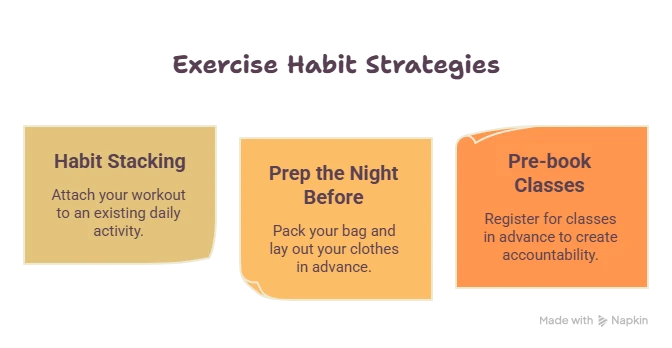
Make exercise a daily habit, not a decision
The goal isn’t willpower. It’s friction reduction. The fewer obstacles between you and showing up, the more consistently you’ll show up.
Three approaches that work:
Habit stacking. Attach your workout to something that already happens in your day. “After I drop the kids at school, I go straight to the studio.” No negotiation with yourself, no daily decision. It just goes on the list of things that happen in the morning.
Prep the night before. Bag packed, clothes out, class booked. When the logistics are solved in advance, mental resistance drops. You’re not deciding whether to go. You’re just getting in the car.
Pre-book your classes. When you’ve already registered for a class, skipping requires actively canceling. Most people won’t make that effort. Research from UCLA Health confirms that social accountability, specifically exercising alongside others who expect you there, is one of the strongest predictors of long-term exercise consistency.
That’s one reason a structured class environment often outperforms solo gym routines for people rebuilding a habit. The class runs whether you feel ready or not.
Stay consistent even when you miss workouts
You will miss sessions. That’s ok. That’s not failure.
“Failure is not defeat, until you stop trying”
The problem isn’t missing a workout. It’s the negative thinking and sabotage. You may tell yourself: “I’ve already ruined this week, I’ll start fresh next month.” That spiral ends more fitness routines than any actual missed session ever has.
Apply the never-miss-twice rule. One missed workout is a rest day. Two in a row is a pattern that needs breaking. The only commitment that matters is not missing two consecutive sessions. One at a time.
Progress isn’t linear week to week. Some weeks are two sessions. Some are four. What matters is the average over three months, not the perfect week that never comes.
Track your fitness progress the right way
Tracking gives you a feedback loop and something concrete to look back at when motivation is low. It doesn’t need to be complicated.
What to track: sessions per week, how you feel the morning after a workout, what’s getting easier. Not calories, not pounds. Those metrics create the wrong relationship with exercise, particularly early on when showing up is the only job.
How to track: a paper notebook, a note in your phone, or just checking classes off as you complete them. The point is visibility. Seeing that you worked out ten times last month is motivating in a way that vague memory never is.
Set small milestones at four weeks, eight weeks, and three months. Acknowledge them. A new piece of gear, a rest day you actually enjoy, a class you’ve been curious about trying.
Fitness Routine Frequently Asked Questions
How many days a week should a beginner work out?
Two to three sessions per week is the right starting point for most beginners. That frequency builds a pattern without overwhelming your body before it adapts. Once you’ve maintained it for four to six weeks without burning out, adding a fourth session makes sense. Consistency at a lower frequency beats intensity you can’t sustain.
How long does it take for a fitness routine to become a habit?
Research suggests around 60 days, though individual timelines vary. The hardest window is weeks two through four, when novelty is gone but the habit hasn’t formed yet. Fixed class times, pre-booked sessions, and a workout partner carry you through that gap until consistency becomes something you don’t have to think about.
What type of workout is best for a consistent fitness routine?
The one you’ll actually show up for. For most people who struggle with consistency, that means choosing something with a fixed schedule, an instructor, and other people around. Group fitness classes check all three boxes and remove the biggest barrier in solo training: having to plan and motivate yourself every single session.
What should a weekly fitness routine include?
A solid routine covers three areas: cardiovascular work (spin, HIIT, Pilates, Zumba, dance fitness), strength (resistance and weight training), and mobility or recovery (yoga, stretching). Many class formats combine two of the three in a single session. Start with two to three sessions per week, add one active recovery day, and build from there.
Is it better to work out in the morning or evening?
Neither is universally better. Morning workouts have fewer scheduling conflicts, and some research shows modest benefits for sleep quality. Evening workouts often feel physically stronger because the body is fully awake. Choose the time you’ll consistently protect and keep everything else out of that slot.
Concusion
The framework comes down to this: a goal with a real reason behind it, an honest starting point, a workout format that fits how you actually live, a schedule that doesn’t rely on daily motivation, systems that reduce friction, a plan for when things go sideways, and enough tracking to stay honest.
No single session changes anything. The months do.
If you’re in Half Moon Bay and want a supportive environment to help your routine, view the current schedule at Highway 1 Fitness and find a class that fits your week. The structure is already built.