Three people can train the same muscle in the same room in three completely different ways. One sits down at a machine. One picks up a pair of dumbbells. One grabs a set of straps and leans back. Same muscle, same effort, three very different demands on the body.
The question is not which one is hardest. It’s which one asks your body to do the thing you actually want to get better at.
Here’s how TRX compares to free weights and machines on load, stability, progression, and results, plus what the research says and where suspension training runs out of road.
The short answer
Machines move on a fixed path. Easiest to learn, best for isolating one muscle, lowest demand on your balance.
Free weights make you control the load through space. Highest ceiling for strength and size, steepest learning curve.
TRX makes you control your own body. Your bodyweight is the resistance, your angle sets the difficulty, and your core stays working on every single rep.
Most people benefit from two of the three. Almost nobody needs to pick just one.
How each type of exercise works on your body
Machines move the weight for you
A machine puts your joints on rails. Cables, pulleys, and guide rods carry the load along a set path, so your stabilizer muscles get to sit out. You change difficulty one way: move the pin.
That’s a real advantage when you’re new, coming back from an injury, or trying to hammer one muscle without your balance giving out first. It’s a limitation when you want the strength to carry over to picking up a kayak.
Free weights make you move the weight
A dumbbell doesn’t care where you take it. No rails, no guide path. Your stabilizers, your core, and your grip all have to cooperate to keep the load where it belongs.
You add difficulty by adding weight. Simple, measurable, and the reason barbells still own the top of the strength ceiling.
TRX makes you move yourself
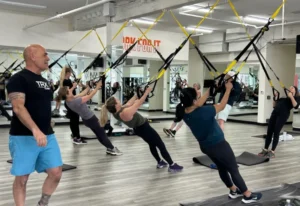
Suspension training flips the equation. You’re the load. The straps hang from a single anchor point and your body angle determines how much of your own weight you’re actually lifting.
Stand more upright on a TRX row and it’s easy. Walk your feet forward until you’re near horizontal and the same movement becomes brutal. The dial is your body position, not a weight stack. That’s the part almost nobody explains, and it’s what makes suspension work scale from a first-timer to an athlete in the same class.
Side by side
| Machines | Free weights | TRX | |
|---|---|---|---|
| How load is set | Weight stack | Plates and dumbbells | Body angle and foot position |
| Stabilizer demand | Low | High | Highest |
| Learning curve | Lowest | Steepest | Moderate |
| Max strength ceiling | Moderate | Highest | Limited by bodyweight |
| Muscle growth potential | High | Highest | Moderate |
| Spinal and joint load | Low, supported | High under heavy loads | Low |
| Space needed | Full gym floor | Rack and floor space | One anchor point |
| Best for | Isolation, rehab, beginners | Strength and size | Core, control, mobility, travel |
What the research actually says
Most articles on this topic repeat the same claim: TRX activates more muscles. The studies are more interesting than the slogan.
Suspension work raises core and stabilizer activation. Researchers wired 25 adults with 16 EMG sensors and compared TRX push-ups, rows, bridges, and planks against the same movements done on the floor. Muscle activity in the trunk and shoulder stabilizers went up on the suspension versions. You can read the muscle activation patterns during suspension training exercises study in full.
Foot position changes the load significantly. A 2023 study in PLOS One measured suspension push-ups and inverted rows against bench press and barbell rows, and found the strap loads correspond to a real percentage of a lifter’s one-rep max. Putting the feet in the straps instead of on the ground pushed both load and muscle activation higher. The full paper on whether suspension exercises provide adequate loads for upper body training is worth a look if you like the details.
Free weights and machines both work, and each wins in its own test. A 2023 meta-analysis pooled 13 studies and 1,016 participants comparing the two. Free-weight training produced bigger gains on free-weight tests. Machine training produced bigger gains on machine tests. Muscle growth came out similar. The researchers behind the free-weight vs machine-based strength training meta-analysis concluded that strength changes are specific to how you train.
Translate that to the gym floor: you get good at what you practice. Train on rails and you get strong on rails. Train while holding yourself in position and you get strong at holding yourself in position.
Where TRX beats free weights and machines
Your core never clocks out. On a machine chest press, your abs do nothing. On a TRX chest press, they hold your whole body in a plank while your arms work.
It scales without changing equipment. Two people at opposite ends of a fitness journey use the same straps in the same class. One stands tall, one walks their feet in. Nobody has to swap dumbbells or wait for a machine.
It’s kind to your spine. No bar on your back, no compression under heavy load. That matters for anyone over 45, anyone with a cranky lower back, and anyone easing back into training.
The range of motion is yours. You’re not adjusting a seat to fit a machine built for the average human. Your shoulders and hips move where they naturally want to move.
Rows without a rack. Single-leg work without your balance collapsing. Assisted squats that let you sink deeper than you could unsupported. Real strength work in about four square feet.
Where TRX loses
We’re not going to pretend suspension training does everything.
You can’t load a squat past your own bodyweight. If your goal is a heavier back squat, straps won’t get you there.
Progressive overload runs out faster. Once you’ve maxed your angle and your tempo, adding difficulty gets creative in a way that adding a 10-pound plate never does.
It’s not the fastest path to serious size. Building noticeable muscle mass long term still favors barbells and dumbbells with steadily increasing load.
Your grip and shoulders fatigue first. On lower body work especially, your upper body can tap out before your legs are finished.
Bad form hides easily. Sagging hips on a TRX plank feel almost the same as good ones. This is exactly why suspension work rewards coaching more than any other tool in the room.
How to actually progress on a TRX
Suspension training does have progressive overload, it just uses different levers.
Change your angle. The single biggest variable. Every step your feet take toward the anchor point increases the percentage of bodyweight you’re moving.
Change your stance. Two feet, then staggered, then single leg. Narrowing your base raises the stability demand without changing anything else.
Change your tempo. A three-second lower turns an easy rep into a hard one. Pause at the bottom and it gets harder again.
Add an eccentric hold. Lower slowly, hold for a beat, then drive back. Time under tension replaces added weight.
Here’s what that looks like on a single movement:
TRX row progression
- Stand nearly upright, feet under the anchor, small lean back
- Walk feet forward 6 inches, torso at roughly 45 degrees
- Walk feet forward until your body is close to parallel with the floor
- Add a two-second pause at the top of each rep
- Move to a staggered or single-leg stance
- Feet in the straps, upper body on the ground, for an inverted row variation
Six levels, one strap, no plates.
Which one should you use?
Chasing maximum strength? Free weights lead. Use TRX for core and accessory work.
Chasing size? Free weights and machines together. TRX for warmups and mobility.
Coming back from an injury? Machines first for the guided path, TRX second under supervision. Talk to your doctor or physical therapist before you start.
Want general fitness, better balance, and a routine you’ll stick with? Suspension-led class work is hard to beat.
Have 45 minutes and want full body? A TRX circuit covers more ground than bouncing between six machines.
Travel constantly? TRX. There’s no argument here. Straps fit in a carry-on.
What a coached TRX class changes
Straps hanging in the corner of a big-box gym mostly go unused, or get used wrong. The variable that determines your entire workload is body angle, and almost nobody sets their own angle correctly without someone watching.
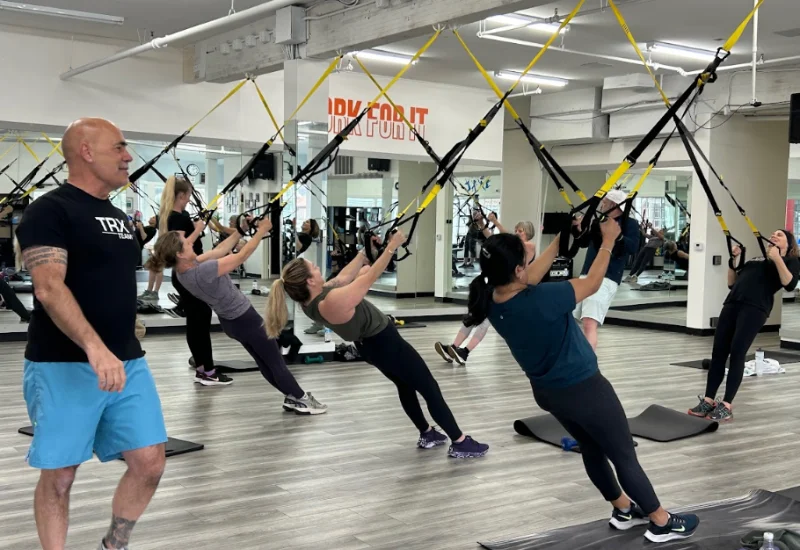
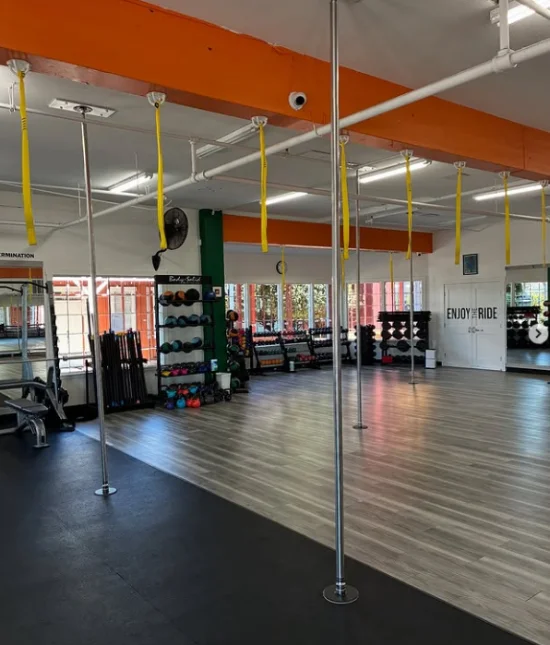
At Highway 1 Fitness, our TRX classes are coached in real time. Our instructors adjust your foot position mid-set, catch the hip sag before it becomes a habit, and give two people at different fitness levels the same challenging session by changing where they stand. Every instructor and trainer on our team is certified and trained in adult first aid and CPR/AED, and several hold specific TRX certifications alongside NASM personal training credentials. You can meet the team behind our classes before you ever walk in.
Our studio in Half Moon Bay runs more than 45 group classes a week across three training areas, including TRX, HIIT, full body strength, Pilates, spin, yoga, and Foundation Training. All levels welcome, every single class.
Ready to try it? Check the current class schedule and book your spot through Mindbody. New to the studio? Our membership and class pass options start with single-class passes, so you can try TRX before committing to anything.
Frequently asked questions
Can you build muscle with TRX alone?
Yes, especially if you’re newer to resistance training. Suspension work provides real mechanical tension and your body adapts to it. Long term, serious muscle growth benefits from added external load, so most people get better results pairing TRX with free weights.
Is TRX better than lifting weights?
Neither is better. They train different qualities. Free weights build maximum strength and size more efficiently. TRX builds core control, stability, and mobility more efficiently. Research shows strength gains are specific to how you train, which is a strong argument for using both.
Is TRX good for beginners?
Absolutely. You control the difficulty by where you stand, so the same exercise works for a complete beginner and a trained athlete. Beginners see the fastest progress in a coached class, where an instructor sets your angle correctly from day one.
How often should you do TRX workouts?
Two to three sessions a week works well for most people, with rest days between. If TRX is your only strength training, three sessions covers full body. If you’re adding it alongside weights, one or two sessions makes a solid supplement.
Is TRX harder than free weights?
Different hard. TRX asks more of your core and stabilizers on every rep. Free weights ask more of your prime movers under heavier load. People walking into their first TRX class after years of lifting are usually surprised by how quickly their trunk fatigues.
Can TRX replace a gym membership?
A strap in a doorway can’t. A studio offering TRX classes can. At Highway 1 Fitness, TRX classes give you the full-body resistance work, core demand, and mobility that straps do best, plus the free weights, strength equipment, and coaching that straps can’t provide on their own. You get the whole range in one place, with an instructor setting your angle so every rep counts. That’s the version of TRX that actually replaces a gym membership. See our class schedule.
The takeaway
Machines guide you. Free weights load you. TRX teaches you to control your own body under tension. Three different jobs, three different tools, and the smartest training plan uses more than one.
If you’ve been lifting for years and your core is the weak link, suspension training will find it in about four minutes. If you’re starting over and barbells feel intimidating, TRX gives you real resistance work without a bar on your back. Either way, the fastest way to find out where you stand is to get on the straps with someone watching your form.
Come try a TRX class at our Half Moon Bay studio. Book your spot on the schedule, or get in touch if you want to talk through which classes fit your goals first. Our trainers will meet you where you are.